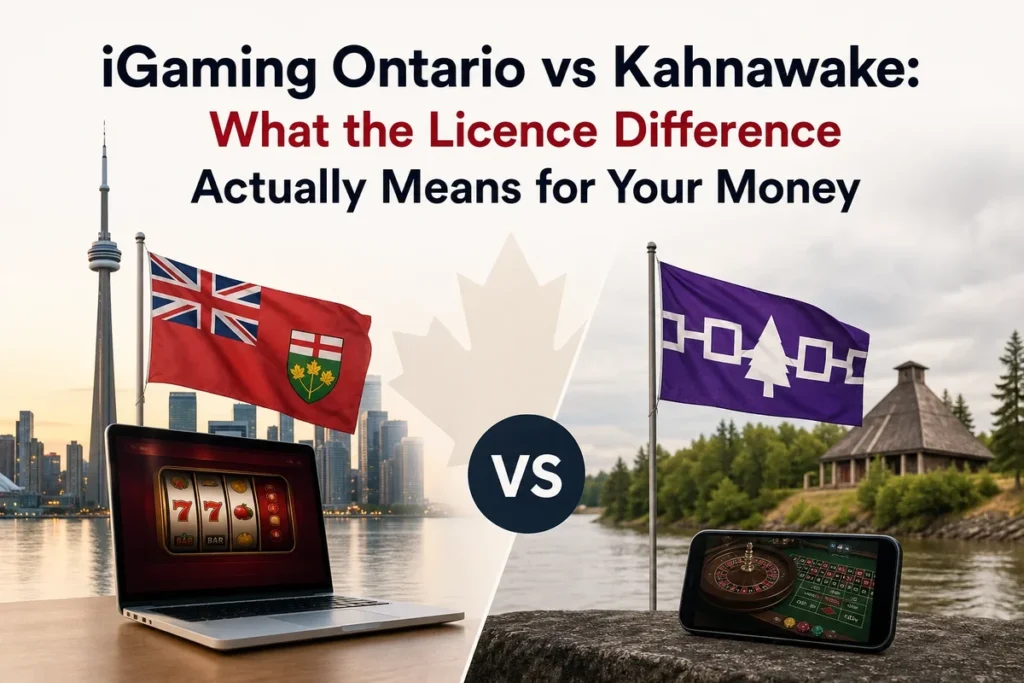
































The Kahnawake Gaming Commission has been licensing online casinos longer than most Canadians have owned a smartphone. Founded in 1999 on Mohawk territory in Quebec, the KGC was one of the first bodies in the world to issue online gaming licences, and for years it was the closest thing Canada had to a domestic regulatory framework for internet gambling. That status is now complicated, by court battles, by provincial competition, and by a Canadian market that looks nothing like it did when the KGC opened for business.
If you play at an offshore casino that targets Canadians, there’s a reasonable chance the licence it displays is a KGC certificate. Understanding what that actually means for your money is the point of this article.
What the KGC Is and Where It Sits in Canada’s Regulatory Map
The Kahnawake Gaming Commission is an independent licensing and regulatory body established under the Kahnawà:ke Gaming Law. It operates from Mohawk territory near Montreal, and its authority derives from Kahnawà:ke’s Indigenous governance framework rather than from any provincial or federal gaming statute. That distinction matters enormously for Canadian players.
The KGC is not affiliated with the Alcohol and Gaming Commission of Ontario (AGCO), iGaming Ontario (iGO), the Alberta Gaming, Liquor and Cannabis board (AGLC), or any other provincial gaming regulator. It has no enforcement authority within Ontario, British Columbia, Alberta, or any other province. When you deposit at a KGC-licensed casino, you are not inside any Canadian provincial consumer protection framework. You are relying on the KGC’s own rules and its willingness to act on them.
That’s not the same as saying a KGC licence is worthless. The commission has operated for over 25 years, maintains a formal complaints process, and requires operators to meet basic technical and financial standards. But the gap between what KGC oversight provides and what a provincial regulator can actually enforce is real, and it shows up most visibly when something goes wrong with a withdrawal.
Which Casinos Popular with Canadians Hold KGC Licences?
Bodog has served Canadian players for over two decades under a KGC licence, with no registration with either AGCO or the AGLC. Ruby Fortune and Platinum Play both carry KGC licences and run on Microgaming software, targeting Canadian players with Canadian-dollar accounts. Yukon Gold and Casino Classic are two more Microgaming-powered, KGC-licensed properties that market directly to Canadians outside Ontario’s regulated framework. These are established operators with long track records, not fly-by-night platforms.
None of them are safely accessible to Ontario players, though. The AGCO actively geoblocks sites not registered under iGaming Ontario. Using a VPN to circumvent that blocking violates operator terms of service and eliminates whatever recourse you might otherwise have had. For players in British Columbia, Saskatchewan, Manitoba, Quebec, and Atlantic Canada, provinces without regulated multi-operator online casino markets, these platforms remain technically accessible. Playing at them has never been a criminal matter for an individual Canadian player. But accessible and protected remain different categories, and that distinction is worth holding onto before depositing real money.
What a KGC Licence Actually Gives You
The KGC requires licensed operators to meet technical standards, submit to financial audits, and participate in a formal disputes process. If a KGC-licensed operator withholds your withdrawal without cause, you can file a complaint with the commission and it will investigate. For long-established operators like Bodog, a track record of not defaulting on player funds counts for something.
What the KGC cannot do is what matters most in a worst-case scenario. Under Ontario’s AGCO framework, every registered operator must hold player deposits in accounts segregated from operating capital, with player fund disputes covered up to C$10,000 according to the AGCO’s Standards for Internet Gaming. Kahnawake’s framework includes no equivalent enforceable segregation requirement at the provincial level. There is no published mechanism guaranteeing a Canadian player’s balance is protected if an operator encounters serious financial trouble.
RTP transparency is another gap. In Ontario, games must pass independent certification from testing bodies such as eCOGRA, GLI, or BMM Testlabs before going live. Many KGC-licensed operators claim eCOGRA auditing, but those claims cannot be independently verified at the provincial level the way they can for an iGO-registered operator. Payment method coverage reflects the same divide. AGCO-licensed operators offer INTERAC, Canada’s own interbank network. Most KGC-licensed offshore casinos cannot access INTERAC at all, because the payment processors that handle it require a level of regulatory compliance that offshore operators do not meet. Our guide to Canadian casino payment methods covers what each payment type means in practice across different types of sites.
Legal Pressure and Internal Governance: The KGC’s 2026 Challenges
The KGC’s most significant recent legal exposure involves the Magic Palace casino, a land-based gaming venue on Kahnawà:ke territory. The owners of Magic Palace launched a lawsuit against the Mohawk Council of Kahnawà:ke and the Gaming Commission seeking $220 million in damages, as reported by Global News and Canadian Gaming Business. The dispute centres on allegations related to the commission’s conduct toward the casino.
In February 2026, Canadian Gaming Business reported that the KGC lost an appeal in the ongoing litigation. A subsequent report from The Eastern Door in March 2026 noted that further proceedings were ordered to continue, with the case unresolved as of mid-2026. For online players, the Magic Palace dispute is not a direct concern, it involves land-based territory governance rather than the commission’s online licensing arm. But a regulator managing significant litigation, operating with interim executive leadership as noted on the KGC’s own website, is a regulator under strain. That context matters when assessing how much weight the commission’s oversight can carry for the online operators it licences.
On the domestic side of its mandate, the KGC’s Gaming Working Group ran a community engagement process through May 2026 focused on expanding Electronic Gaming Device (EGD) permits on Kahnawà:ke territory. Per the Mohawk Council of Kahnawà:ke’s own communications, the engagement was informed by a 2023 market analysis by The Innovation Group, which found the local market could support additional EGDs. This is primarily a land-based governance matter, but it illustrates that the commission’s attention is currently split between its international online licensing operations and domestic oversight responsibilities. The two mandates do not always pull in the same direction.
The Provincial Competition Problem
The single biggest challenge the KGC faces in the Canadian market is not legal or internal. It’s competitive. Ontario’s regulated iGaming market launched in April 2022, and an Ipsos channelization study commissioned by AGCO and iGaming Ontario found that 91.1% of Ontario players now gamble on regulated platforms, up 7.4% from the previous year. Alberta followed with its own regulated multi-operator framework on July 13, 2026, bringing provincial oversight to Canada’s second-largest gaming market.
As more provinces build regulated frameworks, the practical case for offshore alternatives weakens. Players in Ontario and Alberta now have access to licensed casinos offering INTERAC payments, verified RTP standards, mandatory responsible gambling tools, and formal dispute pathways that simply do not exist in the KGC framework. Our roundup of the best online casinos in Canada covers which provincially licensed operators are operating right now. For players in provinces still without regulated private markets, BC, Quebec, Manitoba, Saskatchewan, and Atlantic Canada, KGC-licensed operators remain the primary offshore option, and the KGC’s 25-year track record gives it more credibility than the Curaçao licensing bodies that dominate the crypto-casino space. But the direction of Canadian regulation points toward more provincial frameworks, not fewer.
Responsible Gambling at KGC-Licensed Sites
KGC-licensed operators are generally required to offer responsible gambling tools including deposit limits, self-exclusion options, and referrals to support services. In practice, the quality and enforceability of these tools varies by operator. There is no cross-platform self-exclusion system comparable to Ontario’s BetGuard framework, which connects exclusions across all iGO-registered operators simultaneously. At a KGC-licensed site, a self-exclusion applies only to that specific platform and carries no provincial enforcement mechanism behind it.
If you need help with problem gambling regardless of which platform you use, ConnexOntario is available at 1-866-531-2600 for Ontario players. Alberta players can reach the AGLC problem gambling helpline at 1-866-332-2322. Players in other provinces can contact the national helpline at 1-800-522-4700. A broader overview of what each province offers is in our guide to responsible gambling tools across Canada.
Bottom Line
The Kahnawake Gaming Commission is Canada’s oldest online licensing body and a meaningful step above unregulated Curaçao registrations, but it is not a substitute for provincial oversight, the KGC cannot compel fund releases, cannot verify RTP at the provincial level, and provides no cross-platform self-exclusion. With Ontario fully regulated and Alberta now live, the realistic audience for KGC-licensed sites keeps narrowing to players in provinces that haven’t yet built their own frameworks. If you’re in one of those provinces, know what you’re working with before you deposit.
Sources
- Kahnawake Gaming Commission / MCK Gaming Working Group EGD Engagement Announcement, kahnawake.com, May 2026, kahnawake.com/gaming
- Kahnawake Gaming Commission KGC page, kahnawake.com/gaming/kgc/, accessed June 2026
- Canadian Gaming Business, “Kahnawake Commission Loses Appeal in Magic Palace Lawsuit,” February 23, 2026, canadiangamingbusiness.com
- The Eastern Door, “Magic Palace must wait, court says,” March 20, 2026
- Global News, “Kahnawake casino owners sue Mohawk council, grand chief for $220 million,” May 2025
- AGCO Standards for Internet Gaming, agco.ca
- iGaming Ontario Public Operator Registry, igamingontario.ca
- Ipsos channelization study, commissioned by AGCO and iGaming Ontario, 2025, 2026