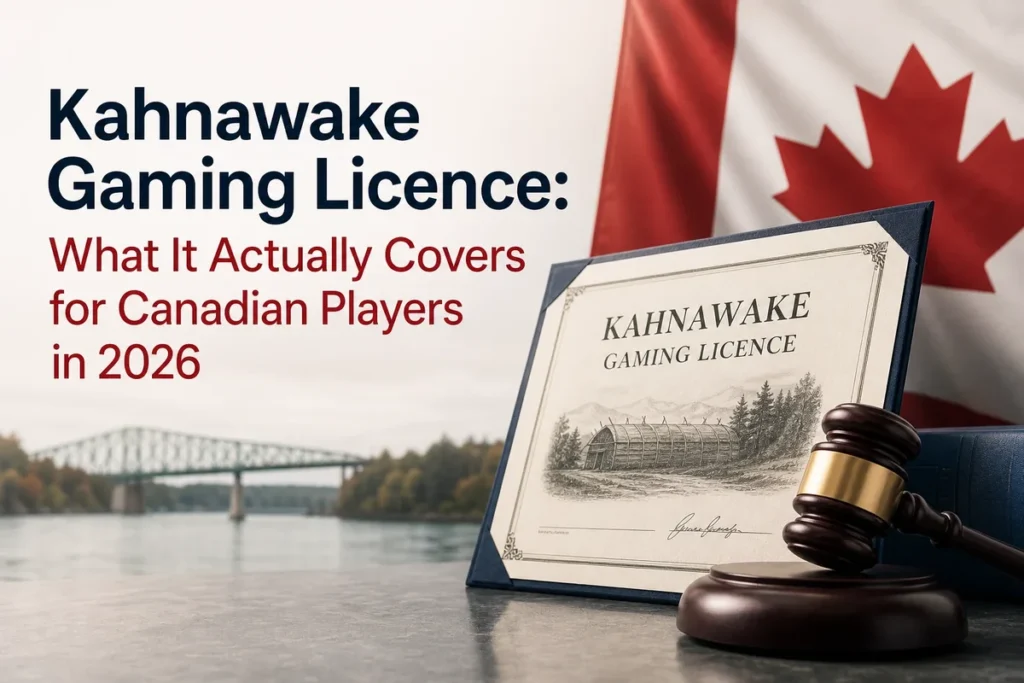



































The Kahnawake Gaming Commission has been issuing online casino licences since 1999. That longevity gives its certificates a veneer of legitimacy that most Curaçao registrations lack, and plenty of affiliate sites treat a KGC licence as roughly equivalent to a provincial one. It isn’t. For Canadian players, understanding exactly where that gap sits, in fund safety, dispute resolution, and responsible gambling tools, is the difference between being protected and being on your own.
What the KGC Is and Where Its Authority Ends
The Kahnawake Gaming Commission is an independent licensing body established under the Kahnawà:ke Gaming Law. It operates from Mohawk territory near Montreal, and its authority derives from Kahnawà:ke’s Indigenous governance framework. That is a real legal foundation. It is not, however, a Canadian provincial or federal one.
No provincial gaming authority in Canada recognises the KGC as an equivalent regulator. The AGCO does not. The AGLC does not. That means when you play at a KGC-licensed casino, you are operating outside every Canadian consumer protection framework that exists at the provincial level. The operator is not required to follow Ontario’s Standards for Internet Gaming. It is not subject to AGLC oversight. Your rights as a player depend entirely on what the KGC’s own rules require, and those rules do not carry the force of Canadian law.
Well-known KGC-licensed operators include Ruby Fortune, Platinum Play, Yukon Gold, and Casino Classic, all Microgaming-powered platforms that have served Canadian players for over a decade. Their track records are real. But track record is a business incentive, not a legal guarantee. Those are different things.
Does a KGC Licence Protect Your Deposited Funds?
Under Ontario’s iGaming Ontario framework, operators are legally required to maintain segregated player fund accounts. Your deposited balance must be held separately from the operator’s operating capital. If an operator encounters financial difficulties, that segregation means your money is not swept into the company’s general assets. The AGCO’s framework protects player funds up to C$10,000 in disputes.
The KGC does not include a comparable segregated fund requirement enforced at the provincial level. There is no published mechanism that guarantees a Canadian player’s deposited balance is protected if a KGC-licensed operator encounters financial difficulties or closes its Canadian-facing operations. The KGC does require operators to pass financial audits and meet technical standards, those are real requirements. But they do not include the same player-fund protections that Ontario and Alberta law mandate.
That gap matters most in a worst-case scenario. If an AGCO-licensed operator fails, there is a legal process. If a KGC-licensed operator disappears, your options are limited. You have no provincial authority to escalate to. You have no legal standing in a Canadian court to compel repayment. You are left with the KGC’s own complaints process, voluntary, not legally binding in Canada.
What Happens When You Have a Dispute?
The KGC does operate a formal complaints and dispute resolution process. It can investigate complaints against licensees and has, in documented cases, required operators to pay out disputed funds. This is not nothing. The KGC has revoked licences in the past for serious non-compliance.
But the process has real limits for Canadian players. The KGC cannot compel an operator to appear before a Canadian court. It cannot impose financial penalties that are enforceable under Canadian law. Its rulings are binding within the Kahnawà:ke Gaming Law framework, but that framework has no jurisdictional reach into Ontario or Alberta’s consumer protection systems. If an operator ignores a KGC ruling, the player’s practical options are slim.
Compare that to Ontario’s model. The AGCO can suspend or revoke a licence for non-compliance. It can direct operators to remedy specific player complaints. It operates within a provincial legal framework where decisions have real teeth. As of mid-2026, Ontario’s regulated market had grown to 48 licensed operators running 82 gaming websites, according to Casino.org’s reporting on Hard Rock Bet’s July 2026 launch. That scale reflects operator confidence in a system with clear rules and clear consequences for breaking them.
RTP and Game Fairness: Verified vs Claimed
Every game on an iGaming Ontario platform must pass independent certification by a recognised testing body. eCOGRA, GLI, and BMM Testlabs are common names. The RTP figure in a game’s help screen is a verified, audited number. Ontario’s framework requires this as a condition of game approval, and some operators publish RTP reports publicly.
KGC-licensed operators often cite eCOGRA or similar bodies in their fairness claims. Some of those certifications are genuine. But they are not subject to Canadian provincial oversight. There is no requirement to publish the results. No provincial body audits the data. You are relying on the operator’s representation of a third-party certification, not an independently verified provincial standard.
Self-Exclusion: A Real Gap in Player Protection
Ontario’s BetGuard system is a centralized self-exclusion registry. One registration excludes you from every AGCO-licensed platform simultaneously. The system is mandatory, operators must check against it before allowing a new account to be created. Within weeks of BetGuard’s launch, more than 500 people had registered, according to figures reported by casino.org. Alberta’s AGLC framework includes an equivalent provincial self-exclusion mechanism.
On KGC-licensed sites, self-exclusion works per operator. You contact one platform to exclude yourself from that platform. There is no shared registry connecting KGC licensees. No cross-platform enforcement. If you want to stop playing across multiple KGC-licensed sites, you must contact each one individually and hope the request is processed. For players who need a firm stop, this is a structural weakness. Our guide to responsible gambling tools in Canada covers both BetGuard and operator-level options in detail.
Who the KGC Actually Serves, and Who It Doesn’t
For players in Ontario and Alberta, the practical question is moot. The AGCO geoblocks all sites not registered under iGaming Ontario. Attempting to access a KGC-licensed casino from an Ontario IP address will typically result in a blocked connection. Using a VPN to work around that block violates the operator’s terms of service and eliminates whatever recourse you might otherwise have had. Alberta’s regulated market launched on July 13, 2026, and the AGLC now oversees online casino operations across the province. As reported by Gaming News Canada, new operators continue to enter both Ontario and Alberta, a signal that the regulated model is working.
For players in provinces without regulated multi-operator markets, British Columbia, Saskatchewan, Manitoba, Quebec, and Atlantic Canada, KGC-licensed sites remain accessible. Playing at them has never been a criminal matter for an individual Canadian player. But accessible and protected are different categories. You are not covered by provincial consumer law. You are not backed by a legal dispute mechanism with enforcement power in Canada. You are playing in a grey zone where the operator’s reputation is the main safeguard, and reputation is not enforceable.
Some well-established KGC operators have served Canadian players for over two decades without major reported incidents. That is worth acknowledging. It is also worth knowing that the KGC’s framework has evolved, the regulator has updated its technical standards and strengthened its complaints process over time, as covered in more detail in our overview of AGCO-licensed Ontario casinos and how the regulated market compares. But evolution is not equivalence. The gap between a KGC licence and an AGCO or AGLC registration remains wide on the three things that matter most when something goes wrong: your funds, your disputes, and your ability to stop playing.
Bottom Line
A Kahnawake Gaming Commission licence means an operator has passed a vetting process run by a long-standing Indigenous regulatory body. It does not mean your deposited funds are legally protected, your disputes are enforceable in Canadian courts, or your self-exclusion request will reach every platform you use. If you are in Ontario or Alberta, regulated alternatives exist and the offshore route is effectively closed. If you are elsewhere in Canada, the KGC offers some baseline standards, but none of the enforceable consumer protections that provincial regulation provides.
Sources
- iGaming Ontario, Public Operator Registry: igamingontario.ca
- Kahnawake Gaming Commission, Official Site: kahnawakegaming.com
- AGCO, Standards for Internet Gaming: agco.ca
- Casino.org, “Hard Rock Bet Launches in Ontario as Province Reaches 48 Licensed Operators”, Mark Keast, July 23, 2026: casino.org
- Gaming News Canada, “New operators entering Ontario, Alberta are signs of stable regulated gambling sectors”, Dave Briggs, July 29, 2026: gamingnewscanada.ca
- Canadian Gaming Business, “Entain’s Sports Interaction and Party Casino launch in regulated Alberta market”, July 23, 2026: canadiangamingbusiness.com